

Decades of research on high-performing education systems have demonstrated the need for strategic, forward-looking system leadership.
NECC Report, page 31
In his controversial book published in 2005 titled The World is Flat, Thomas Friedman famously describes the concept of a vastly interconnected world where he argues that technological advancements, globalisation, and the internet have “flattened” the world, creating an interconnected global playing field. In this world, individuals, companies, and nations are more interdependent than ever before.
In the book Friedman emphasised the need for systems thinking to navigate this interconnectedness. He highlights that in a globalised world, no issue or action occurs in isolation; everything is part of a broader, complex system. Understanding how one part of the system influences another is critical for addressing challenges such as climate change, economic instability, or international relations. His key takeaway is that in a “flat” world, one must think in terms of relationships, patterns, and systems to fully grasp the dynamic and ever-evolving global landscape.
While Friedman focused largely on the economic aspects of this global interconnectedness, the same thinking applies across almost everything we do in our modern context – including education. It is the ability to grasp this complex interconnectedness – at a local or global level – that differentiates an organisation leader from a system leader/thinker.
How is this relevant to school leadership?
As a school principal or educator, embracing systems thinking can revolutionise your approach to school management and student success. At its core, systems thinking is a holistic approach that focuses on how various elements within the broader education ecosystem interact and influence each other, rather than viewing challenges through a narrow, linear lens focused purely on the issue or problem at hand.
The problem often is, however, that the daily focus of our work isn’t conducive to this sort of thinking. In many of my conversations with school principals I find that their day-to-day focus is often directed towards single issues that happen to be ‘on top’ for a variety of reasons. This is a sign of an organisational leader, with solutions being found that suit that particular context and time, but which may not be suitable for scaling out or being sustained beyond that.
Systems thinking helps school leaders visualise the complex network they operate within and understand the far-reaching implications of their decisions. This understanding can lead to more thoughtful, holistic approaches to school management and educational policy implementation. This begins with understanding that a school is not simply a building or an isolated institution. Rather, it exists within a complex network of interconnected elements. These elements include students, teachers, staff, curriculum, policies, resources, and the broader community.
The diagram below is an attempt to illustrate this interconnectedness of the educational system, starting with the school at the centre (dark blue) and the specific elements that require the focus of the school leadership within that. (I realise that many readers will argue that the student should be at the centre of our work – and I’d agree, however, for the purpose of what is being illustrated here, I’ve chosen to focus on the entity of a school – see more below).
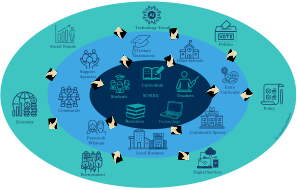
To make sense of this image, start with the central “School” (dark blue oval), as this is the school leader’s primary domain of influence. Within this are the micro-level elements within the school, including teachers, students, curriculum, resources and technology. There is a constant interaction between these elements occurring everyday, and a this level a principal is constantly aware of and monitoring things such as classroom dynamics, teacher-student relationships, curriculum implementation and resource allocation and so forth. From a systems-thinking point of view, it is important that an effective leader is considering these inter-relationships and not simply focusing on one element at the exclusion of the others. Think, for example, of the exercise that goes on when matching students with teachers at the beginning of the school year, where it is recognised that some students respond well to some teachers and not so with others. Or where the selection of resources must align with what the curriculum requires, but also be appropriate to the age and context of learners.
The next level out (light blue) shows how the school interacts with immediate external factors like parents, community, and local organisations etc. These are the elements with which the learner and her/his family/whānau are most likely to be connected with in some way in their lives outside of school. Similarly, many of these elements are accessed by the school as it seeks to be more relevant to the needs of its learners and more available to the local community. At this level a principal may be engaged in fostering parent-school partnerships, local community engagement, building connections with extracurricular activities and clubs and creating opportunities for engagement with local businesses and organisations. Think here of students who are engaged in out-of-school sports or cultural clubs or events, and how this is recognised as ‘learning’, or when use is made of community facilities such as libraries, museums or swimming pools as alternative venues for learning to what is available inside the school. Think also of the opportunities for expanding into various forms of internships and work experience where local businesses and organisations provide the context for learning outside of the classroom. Then there are the learning pathways we need to consider if we are being truly learner-centred in our curriculum design. For example, the links between local schools to ensure there are pathways between primary (elementary), intermediate (middle) and secondary schooling – something the formation of Kahui Ako (clusters of schools) was intended to address in New Zealand.
Finally, there are the macro-level elements (green), demonstrating how broader societal factors (national and global) bring influence to and are influenced by the educational system. This is where the critical skill of environment scanning needs to be considered for all leaders. It is important that leaders in schools have developed ways to keep abreast of trends at a national and global level in terms of education policies, cultural and social trends, technology trends and economic trends and factors. Any strategic decisions made at a local school level without an awareness of these things runs the risk of being limited in terms of scalability or sustainability. Worse, a lack of awareness of national and global trends leads to increased anxiety when change happens as, instead of being able to recognised the drivers of change and the responses that are being made elsewhere, an ‘unaware’ leader finds themselves always reacting to what’s happening and unable to act pro-actively in ways that build resilience and preparation for change.
The small, yellow arrows indicate the two-way interactions or pathways of connection and influence that are constantly occurring.
Why is Thinking Like This Important?
Systems thinking is important because there is a ripple effect to any decision making by leaders in schools. Decisions made at the school level can have far-reaching consequences beyond the immediate school environment. For example, changing school start times might affect not only student performance but also family schedules, local traffic patterns, and even community businesses.
Then there’s the issue of the holistic approach to student development. We must recognise that a child’s education is influenced by factors both inside and outside the school. Effective school leaders are constantly collaborating with social support agencies, healthcare providers, and extracurricular organisations to support the whole child.
Understanding the school as part of a larger system helps in anticipating and adapting to changes, and builds adaptability and resilience. We saw this happen during the COVID pandemic, where schools that were already functioning effectively with flipped classroom models, with staff and students able to access their learning from home being far better prepared to the extended period of school closures. We can also think of the benefits of being prepared for shifts in demographics, technology, or educational priorities.
Many schools struggle with the increased burden placed upon them of operating as autonomous, self-managing entities – particularly smaller and medium-sized schools. Being a systems thinker means naturally having the ability to identify and utilise connections within the system to create positive change. For example, partnering with local businesses for internship programs or with community organisations for service-learning opportunities. In addition, the support experienced when leaders are connected to others through professional learning networks cannot be underestimated. It is an effective way to encourage principals to consider the long-term implications of their decisions on the entire educational ecosystem, and fosters a culture of continuous improvement and learning within the system.
What does this mean for leaders?
A recent NECC report titled Blueprint: Designing Systems That Work points to the traditional fundamentals of leadership as the floor, no longer the ceiling, and highlights what is required of leaders given the pace of change in education and the economy. This quote from page 32 highlights what this change might look like:
The highest performing education systems in the world share a relentless focus on alignment. They coordinate their efforts vertically and across the wide range of partners necessary for student success. These top performers ensure that curriculum, assessments, instruction, and teacher training all push in the same direction. But they go further, extending systems alignment beyond K–12 to include early childhood education, career and technical education, higher education, and lifelong learning. The leaders of these systems build guiding coalitions that work at the intersections of P-20 education, business, and other government agencies—such as housing, health care, and social services. They recognise that the parts and pieces of the system must all reinforce and support each other around a clear and limited set of goals.
In essence, this means that education leaders need to strive to become better at systems-thinking, and not be captured by the day to day demands of managing their organisation. This is not to say that organisational leadership is a bad thing – it isn’t. In fact, organisational leadership is a very necessary part of operating a great school. But often these responsibilities can be shared among an effective senior leadership team and board. This can be an extremely effective approach to growing new leaders and helping them advance in their careers – as well as providing the immediate benefits of a distributed leadership environment. The problem emerges where being an organisational leader becomes the primary focus of a school leader’s behaviour – which can result in ‘overwhelm’ and burnout, or other unintended consequences where there is an unhealthy emphasis on competing with other schools in order to become a local ‘school of choice’ for example.
The table below is my attempt to illustrate what some of the behaviours look like when comparing the two styles of leadership:

What you can do
The prompt to write this post occurred when I was asked by one of the principals attending the 3Rs Programme how I would explain ‘systems thinking’. I was caught a little unprepared, but I managed to respond in a way I hope was useful. I imagine the question was prompted by the challenge I’d given this group during our first session together where I asked whether they considered themselves as leaders of organisations or as system leaders.
As we’ve introduced here the importance of systems thinking in education, it’s clear that this approach can revolutionise how we lead and manage our schools. But understanding the concept is just the first step. Here are some ideas about how you can start applying systems thinking in your role as an education leader:
- Broaden Your Perspective: Challenge yourself to look beyond the immediate issues. When faced with a problem, ask: “How does this connect to other aspects of our school or community?”
- Map Your Ecosystem: Create a visual representation of your school’s ecosystem, similar to the diagram in this post. Include all stakeholders, resources, and external factors that influence your school.
- Foster Cross-Functional Collaboration: Encourage regular meetings between different departments or roles within your school. This could include teachers from different subjects, administrative staff, and support services.
- Engage with the Community: Set up partnerships with local businesses, community organizations, and other schools. These connections can provide valuable resources and real-world learning opportunities for students.
- Share Your Journey: Document your experiences with systems thinking and share them with other education leaders. This could be through blog posts, conference presentations, or professional learning communities.
- Implement Feedback Loops: Establish systems to gather and act on feedback from all stakeholders – students, teachers, parents, and community members. This will help you understand the ripple effects of your decisions.
- Practice Scenario Planning: Regularly engage in “what if” exercises with your leadership team. This can help you anticipate potential challenges and prepare for various future scenarios.
- Invest in Professional Development: Seek out training opportunities in systems thinking for yourself and your staff. This could include workshops, online courses, or bringing in expert speakers.
- Stay Informed on Global Trends: Dedicate time each week to reading about global education trends, technological advancements, and societal changes that could impact your school.
- Reflect and Adapt: Regularly assess the effectiveness of your strategies. Be willing to adapt your approach based on what you learn.
Remember, becoming a systems thinker is a journey, not a destination. It requires patience, practice, and a willingness to challenge your own assumptions. By embracing systems thinking, we can create more resilient, adaptive, and effective schools that truly serve the needs of our students and communities. Let’s start this transformative journey together!
But wait… there’s more!
In the coming weeks, I’ll be diving deeper into specific examples of how systems thinking can be applied in schools. These practical examples will serve to illustrate how important systems-thinking is for leaders in our schools.

If you’d like to learn more about becoming an effective systems-thinker and system leader, why not enrol to participate in our Refresh, Reconnect, Refocus professional learning programme in 2025?
Following the highly successful programme for principals in 2024, we are offering the programme twice in 2025, one for principals the the second for AP/DPs. Click on the link below to access all the information you require and find links to the online enrolment form.
Here’s what some of the 2024 participants had to say…
“The programme has re-ignited my leadership focus. I feel re-energised, re-focused and ready for action! Not only have I rediscovered my motivation for leadership, but I also gained a support network of like minded people I feel I can call on when needed. I don’t particularly have that in my own context, but I’ve found it here.“
“This programme offers all the good stuff: a retreat but guilt-free workshop, a new network, practical and tested ideas for leadership, future of education insights, 1:1 coaching, ongoing peer support and bite size professional learning invites – all with just the right amount for busy Principals to engage with.”



8 replies on “Systems Thinking”
Shame Stanford and Luxon are totally unaware of systems thinking ( have you read Margaret Wheatley book Leadership and the New Science?)
Thanks Bruce. I hadn’t come across Margaret Wheatley’s book – will have to check it out!
[…] my previous post I explored the idea of systems thinking, providing some conceptual ways of thinking about how a […]
[…] third of a series of posts I am writing about system-thinking and systems-thinking leadership. My first post outlined some of the background to what systems thinking is about and the second applied the idea of […]
[…] Wenmouth articles on systems-thinking leadership applied to school lunches & mobile […]
[…] the process Maurie and I emphasised the importance for participants to think of themselves as system leaders, rather than simply leaders of an organisation. While it is both inevitable and important that […]
[…] Social Staircase Time For Resilience Planning! Bringing Back the Inkwells! Focus on Citizenship Systems Thinking It’s about system, not structure Getting Serious About Our Future If you can’t […]
It’s great to see some real depth in systems thinking coming through in this work. It’s a refreshing change from the quick-fix mindset that often dominates problem solving.
Not many teams in education or even in industry, take the time to look at how problems play out over time, explore feedback loops, or consider both the practical and human sides of an issue. This kind of thinking is not just needed, it’s encouraging to see it being done well.