

In my previous post I explored the idea of systems thinking, providing some conceptual ways of thinking about how a systems thinking leader differs from being an organisational leader. In my next few posts I thought I’d take a specific issue or concern shared by school leaders at the moment, and explore the different approaches and perspectives taken when approaching the issue through an organisational lens vs a systems-thinking lens.
For this post I’ve chosen an issue that is currently quite topical here in New Zealand – school lunches, since the current approach to providing lunches for students at school is under review.
Across the world different countries have addressed this concern with various forms of lunches in schools programmes, including New Zealand (although New Zealand’s free school lunch programme, Ka Ora, Ka Ako – Healthy School Lunches, was only launched by the Labour government in 2019). Before this, many teachers or schools were providing food for students entering their classrooms having had no breakfast, and some, no meal the evening before, out of their own pockets (I remember doing this back when I started teaching in the 1970s – usually a snack bar or something similar that I could easily keep in my desk drawer). It was a simple choice – provide the student with something to satiate their hunger or have to tolerate the behaviours of a child unable to focus for the day.
Various studies have shown that not only does this increase the wellbeing of a student – but there’s clear evidence suggesting that healthy students are better able to focus on their learning, and that academic achievement can therefore increase (something that Maslow’s hierachy of needs has underpinned for years!). Research indicates that providing free school lunches can enhance academic performance across various demographics, as demonstrated in New York City middle schools. Universal school lunch programs have also been linked to improved dietary quality and food security for students, benefitting both individuals and families. These initiatives not only support student nutrition but also positively impact local economies, contributing to a broader community well-being.
So at one level it’s easy to understand the need to provide lunches as a way of addressing the immediate need of a hungry student, but there’s a challenge that comes with that as providing food costs money, and that needs to be found from within the education budget (usually). So while many are in favour of this expenditure, others see it as a responsibility of parents and that schools shouldn’t have to pay.
From an organisation’s spreadsheet perspective it’s easy then to either stop such activity altogether, or to reduce the cost of what is provided in some way (often at the expense of nutritional content.) But a system thinker will contemplate of all of the factors feeding into this issue – beyond simply what it costs to provide the meal. This includes the complex interconnectedness of issues such as the ability of parents to make decisions about feeding their children, the increase in consumption of food that doesn’t provide the required nutrition, and the positive outcomes for ensuring children are fed well that extend beyond simply helping them focus on their schoolwork (i.e. setting patterns of behaviour for later life etc.)
The diagrams below illustrate how we might consider the different approaches:
Organisational Leader
An organisational leader’s approach to the provision of school lunches is more likely to have an immediate, operational focus, responding to concerns as illustrated below:
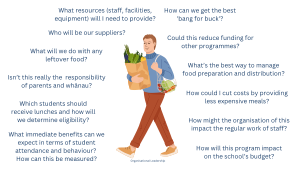
Systems-thinking Leader
A systems-thinking leader’s approach to school lunches is more likely to be holistic and take a longer term perspective, being mindful of the range of inter-connected issues at play, considering ideas as illustrated below:

It’s very important here to understand that it’s not about one approach being right and the other wrong. There are most certainly times when we need to apply our organisational focus as leaders, to ensure the immediate concerns are met and systems and processes are working smoothly to ensure success. But if that’s all we do we are at risk of missing the bigger picture and the opportunity to set in place solutions that will potentially be much more meaningful and impactful on our students, their parents and families, and our society into the future.
This is just one example of where system-thinking can help move the dial on helping us achieve those longer-term, more impactful goals. Not everything is about spreadsheets and managing localised systems or immediate concerns. As important as it is that the meals that are sourced can fit within the available budget, simply providing something that the students can eat without considering things such as nutritional value, dietry needs and cultural requirements for example misses the opportunity that the provision of school lunches provides to address some of the broader issues and concerns around the causes of poverty and nutrition education for example.
Solutions
While the focus of the organisational leader will likely result in the implementation of solutions that meet the immediate need and will often be determined by consideration of the budget available, the solutions sought by a systems-thinking leader will likely be more long-term and future focused. Just some of these ideas are listed below as examples..
Focus on a more holistic nutrition approach
- Integrate nutrition education into the curriculum, potentially earning students NCEA credits.
- Implement school gardens to connect students with food sources and provide fresh ingredients for garden-to-table experience.
Community collaboration
- Partner with local food growers and community gardens for sustainable, culturally relevant ingredients.
- Implement programs like Kura Kai, providing freezers for community meal access.
Long-term skill development
- Involve students in meal planning, budgeting, and cooking, fostering life skills.
- Offer food-related classes to introduce new foods and reduce stigma for those perhaps haven’t tried certain foods.
Inclusive food environment
- Create shame-free spaces for students to access food or advice anytime.
- Develop multicultural menus that cater to diverse food preferences and cultures.
Your turn
Take a moment to consider how systems-thinking could be applied in your school or community when making decisions about the provision of lunches for students. Here are some thoughts to inspire action…
- Share this blog post with colleagues, parents, or community leaders to spark a conversation.
- Look at your current school lunch program (if you have one) through a systems-thinking lens. Identify at least three interconnected factors that influence its success or challenges that exist in your context.
- Organise a meeting or online forum with diverse stakeholders (educators, parents, students, local food producers, nutritionists) to discuss a holistic approach to school nutrition – perhaps initially with staff, and then with your community.
- Implement one small change inspired by systems-thinking, such as introducing a school garden or a nutrition education component. Document the process and outcomes and share this with others in appropriate forums.
- Use the insights from your systems-thinking approach to advocate for more comprehensive, long-term solutions in your school or at the policy level. Consider who you might gather around you to achieve this.
But wait… there’s more!
This is the second of a series of posts I am writing about system-thinking and systems-thinking leadership. My first post outlined some of the background to what systems thinking is about. In my next post I will explore the issue of systems-thinking and the issue of mobile devices for learning.

If you’d like to learn more about becoming an effective systems-thinker and system leader, why not enrol to participate in our Refresh, Reconnect, Refocus professional learning programme in 2025?
Following the highly successful programme for principals in 2024, we are offering the programme twice in 2025, one for principals the the second for AP/DPs. Click on the link below to access all the information you require and find links to the online enrolment form.
Here’s what some of the 2024 participants had to say…
“The programme has re-ignited my leadership focus. I feel re-energised, re-focused and ready for action! Not only have I rediscovered my motivation for leadership, but I also gained a support network of like minded people I feel I can call on when needed. I don’t particularly have that in my own context, but I’ve found it here.“
“This programme offers all the good stuff: a retreat but guilt-free workshop, a new network, practical and tested ideas for leadership, future of education insights, 1:1 coaching, ongoing peer support and bite size professional learning invites – all with just the right amount for busy Principals to engage with.”



3 replies on “Systems Thinking: School Lunches”
[…] on from my previous post about Systems Thinking and School lunches, a second example we could use to illustrate systems thinking is the provision of mobile devices […]
[…] on from my previous posts about Systems Thinking and School lunches, and systems thinking and mobile devices, this post considers systems thinking and virtual learning […]
[…] Wenmouth articles on systems-thinking leadership applied to school lunches & mobile […]