Virtual Learning
Following on from my previous posts about Systems Thinking and School lunches, and systems thinking and mobile devices, this post considers systems thinking and virtual learning within the schooling ecosystem in New Zealand (and beyond). Distance Education for school-aged students has existed in New Zealand for over a century through the work of Te Kura (formerly the Correspondence School). In more recent times there have been a number of new entrants into the distance education scene, enabled, to a large extent, by developments in technology that make it easier for people to connect with each other while separated by geography.
What’s driving this?
There are a number of possible reasons – both practical and philosophical – for why virtual learning is increasingly being explored and used in the schooling sector. Fundamentally, our current structures and system are struggling to meet the needs of an increasingly diverse needs of learners, and to respond to the constantly changing needs of the workforce and society more generally.
Consider the following challenges that face teachers and principals in many of our schools currently…
- Difficulty in recruiting and retaining staff – particularly in areas requiring specialist knowledge or skill
- Lack of ability to provide the breadth of subject options at secondary school level due to size of school and limited staffing available
- Challenges in sustaining continuity of teaching and learning in circumstances when schools are forced to close due to extreme weather events or natural disasters
- Problems with student motivation and engagement when forced to participate in programmes that don’t address their needs or career ambitions
- Challenges in accessing assistance and specialist programmes for students with special learning needs – including support and assistance for parents at home with these learners
- Difficulties with timetable ‘streams’ that create clashes for some students who don’t want to follow traditional course selection patterns
- Specialist staff feeling compelled to leave their current positions to find employment in larger schools when wanting to find better career options in their specialist areas
- Challenges in connecting with specialist knowledge and expertise from outside the education system – e.g. community and business or global expertise
- Students missing regular class time to attend sporting or cultural events – especially where they may be participating at representative level and wishing to pursue this beyond school
- Other students missing out on class time due to extended periods of recuperation from illness or injury that requires them to stay at home or in care
These are just some of the issues I come across frequently when talking with teachers and school leaders. While none of them are new exactly, they do seem to be escalating in frequency and level of impact on both students and schools. They illustrate the extent to which our ‘one-size-fits-all’ model of ‘school’ as we know it, with the expectation that all students will attend class on a regular basis where they are taught by a teacher, is no longer ‘fit for purpose’ in the modern era.
Responding to these challenges
My concern here is that when responding to these challenges many school leaders become bogged down in addressing the urgency of the need, and don’t engage in the thinking required to take a ‘whole of system’ view of what’s happening. As I have done in my previous ‘systems thinking’ posts, the images below illustrate the difference between organisational leadership and systems-thinking leadership in relation to the introduction of virtual learning…
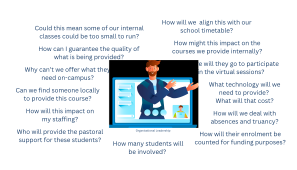
(a) Organisational leader
The organisational leader will focus primarily on how they can manage things within their own school setting – ensuring minimal disruption to the ‘normal’ way of operating, and making sure there is little or no impact on the ability of the school to offer and staff their current courses. Embracing virtual learning will tend to be regarded as a ‘temporary fix’ or something done in addition to the core provision of curriculum within the school.
(b) Systems-thinking leader
In addition to many of the things being considered by the organisational leader, the system-thinking leader will consider how this might play out in the longer term, what will be required to create a sustainable way of operating, and what changes might be required to things such as the funding and policy settings to take account of these new ways of working.
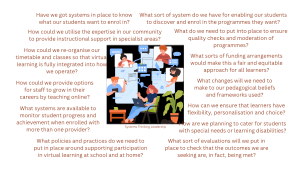
As highlighted in my previous posts – this isn’t about an ‘either-or’ choice. It simply serves to illustrate how systems-thinking and system-leadership transcend the immediate concerns of the local school and take into account a much broader and more complex set of questions that will ultimately prepare the way for a transformation in the way things are done, rather than simply accommodating virtual learning as more of a ‘stop gap’ measure to address immediate needs.
Some years ago now I led a group of educators associated with the Virtual Learning Network to create a handbook to guide other schools and clusters as they sought to establish local clusters of schools that could support each other by sharing teachers and courses in a virtual learning approach. The Learning Communities Online Handbook has since disappeared from the Ministry of Education’s website – but you can download it here as a reference for the sorts of things that these education leaders considered at the time as being important. So much of the advice in the Phase 5 Column (Maturity/sustainability) of the matrix on page 19 reflects the sorts of things a system leader needs to be thinking about.
The Emerging Paradigm
While it’s easy at one level to use the industrial argument to characterise our education system as being somewhat ‘static’ and unresponsive (to the needs of learners at least), a look at the trends that have been evolving over the past few decades highlights the direction things appear to be moving. Driven by a combination of emerging technologies and the desire to create a response to the sorts of issues listed above, we’ve seen a steady shift towards the use of virtual learning under a variety of guises.
I created the image below (or an early version of it) while working at Te Kura (The Correspondence School) twenty years ago, when we were experiencing a huge upswing in the use of the World Wide Web in schools to access information and resources, and of learning management systems to bring some sort of ‘order’ to how online instruction was provided for distance students. The concept of flipped classrooms and blended learning was on the horizon, as was the concept of online/virtual schools that were emerging in places such as the Florida Virtual School in the US.
My illustration was an attempt to look ahead by 20 years to imagine where we might be once these things had matured and we might find ourselves in a time where, instead of being viewed as separate domains of activity, we might find ourselves operating in an ecosystem where virtual learning is simply a part of the ‘way we do things’ in education, providing students (and teachers) with the opportunity to access the learning they want/need at the time and in the place they want/need.

As you can see, I’ve tried to illustrate the convergence of traditional face-to-face contexts with traditional distance (correspondence) education over time, taking into account the impact of the WWW and other technological advances that have ‘closed the gap’ between these domains. The ‘end state’ I foresee is where there is no distinction between the two. Rather, all learning takes place within a digitally connected learning ecosystem, where organisations such as schools still exist, but are ‘boundary-less’, with students who attend being able to access learning from outside the physical school buildings – including through engagement in various forms of community-based learning, or through access to virtual learning opportunities in a range of forms.
While I may have been a bit optimistic about getting there in 20 years, I am still confident that this is the future we’ll find ourselves designing and working in before too long. I have to confess that, during the COVID response I felt we may have been at a tipping point to see this happen, with the growing interest in hybrid learning. Sadly, it seems I significantly underestimated the ‘pull’ of the system to want to ‘return to normal’ (aka the industrial model of one-size-fits-all, delivery of education).
What can Virtual Learning offer?
Virtual learning is certainly not the binary option for addressing the issues and concerns raised earlier in this post. I’m certainly not an advocate for closing schools down and putting all students online. I am, however, an advocate for being more intentional about embracing the potential of virtual learning as a part of the learning ecosystem we are creating for our students, our staff and our communities. Virtual learning has a lot more to offer our education system than simply providing access to courses or subjects that students may not be able to access in the school they attend physically. Consider, for example, the following list of benefits virtual learning may provide if designed and implemented well…
- The ability to provide access to specialist teaching resources that may not be available locally. For example, many schools have learners enrolled in Te Kura to enable them to access learning in specialist areas that aren’t available in their local school. This is also a key driver behind the establishment and operation of the Virtual Learning Network, where schools collaborate as both providers and receivers of specialist subject teaching that allows their students to remain in their local school but still access the subjects they wish to pursue.
- It addresses the desire to bridge the gap between home and school learning environments, creating a more seamless educational experience. The increased use of digital devices and online environments for learning have led to the concept of ‘homework’ simply being an extension of the learning that is taking place at school. This was the origin of the concept of the ‘flipped classroom’ and ‘blended learning’ where the aim is to increase student engagement and learning by having learners complete readings at home, and work on live problem-solving during class time. The increased emphasis on recognising parents as partners in the learning process is another reason for activity in this area as they can have better visibility of the things their child is doing, providing support that is targeted and purposeful.
- Achieves the goal of building system resilience to maintain educational continuity during crises or unexpected school closures. As we saw during COVID, those schools that already has systems in place for connecting home and school learning were well equipped to maintain their connection with students during the period that schools were closed, providing ongoing instructional and pastoral support via virtual learning environments. There are a range of other reasons schools find themselves unable to remain open from time to time, including natural disasters and weather events – and virtual learning can be seen as helping to establish a level of system resilience in such events.
- It provides the ability to accommodate students unable to attend in-person due to health issues or extracurricular commitments like elite sports. Besides things like the weather or natural disasters that force the closure of schools, there are other circumstances that prevent individuals from attending for periods of time – including those recovering from a variety of health-related issues, and those who take time out to pursue high level sporting, cultural or special interest pursuits. The three health schools in NZ exist to support students in this way – but many other schools are forced to explore similar strategies on a case-by-case basis where they encounter students with these sorts of needs.
- It presents an opportunity to generate additional revenue by expanding educational offerings to international students through online platforms. It needs to be acknowledged also that there are a number of schools and private providers emerging in the marketplace who see the opportunity to generate revenue by making their programmes available to a wider audience of students, predominantly those who are international.
Where to start…
In this post I’ve tried to illustrate the importance of taking a systems leadership approach when considering virtual learning as a part of our wider education ecosystem. While at one level a systems-thinking approach requires consideration of the wider context of education and society outside of the school, when considering virtual learning opportunities for students, school leaders should focus on several key aspects of the school as a system. If you’re contemplating introducing more virtual learning experiences for your students into your school programme, here are some important points and questions you should consider:
Infrastructure and Technology
School leaders need to evaluate their existing technological infrastructure and consider:
- Is your current network capacity sufficient to support widespread use of the online tools, platforms and data storage required for virtual learning?
- Do you have the necessary hardware (devices, cameras, microphones) for both teachers and students?
- What learning management system (LMS) or virtual learning environment (VLE) will best serve your needs?
Pedagogical Approach
The shift to virtual learning requires a rethinking and redesign of teaching methods:
- How might you adapt our curriculum for effective online delivery? What changes would be required? How can you accommodate changes in curriculum content and contexts to suit different learner groups?
- What professional development will your teachers need to become confident and competent in virtual instruction?
- How can you ensure active student engagement in a virtual environment? How must the approaches differ from regular in-classroom instruction?
Equity and Access
Ensuring equal access to virtual learning opportunities is one of the key drivers behind many virtual learning initiatives:
- How can you address the digital divide among your student population? How will you ensure all students have reliable internet access and appropriate devices?
- How will you monitor your programmes and intervene as required where barriers to access and participation are identified?
- What support will you provide for students with special needs or learning disabilities?
Student Support Systems
Robust support structures and systems to support all students are essential:
- How can you provide effective support in a virtual setting – both academic and pastoral?
- What mental health and well-being services should you consider offering virtually? Who will be charged with this responsibility?
- How can we maintain a sense of community and social interaction among students? What protocols need to be established to ensure the safety of participants in the online community?
Assessment and Evaluation
Traditional assessment methods may not be appropriate in a virtual environment and may need to be adapted:
- What alternative assessment methods are suitable for online learning?
- How do you plan to ensure academic integrity in these virtual assessments?
- How do you plan to track student progress and provide timely feedback in a virtual environment?
- How will assessment data be shared between different providers? What access and control will the learner have over this data?
Teacher Training and Support
You cannot assume that an effective classroom teacher will automatically be effective in the virtual environment:
- What ongoing professional development will be needed for effective online teaching?
- How can you support teachers in managing their workload and well-being?
- What resources and tools do teachers need to create engaging virtual content?
Parent/whānau Engagement
Parents/whānau play a crucial role in supporting learners in virtual learning:
- How will you effectively communicate with and support parents in this new learning environment?
- What access is appropriate for them to the virtual learning systems being used, and how might they use these in support of their child?
- What resources can you provide to help parents assist their children with virtual learning?
- How will you address parents’ concerns about screen time and online safety?
Flexibility and Personalisation
The ability to personalise the learning experience should be a key feature of virtual education:
- How can you leverage virtual tools to offer more personalised learning paths?
- What strategies can you employ to accommodate differences in the time, place and pace of learning?
- How might you balance synchronous and asynchronous learning opportunities? How will you make these decisions?
Conclusion
As we navigate the evolving landscape of education, embracing virtual learning as an integral part of our educational ecosystem is no longer optional – it’s imperative. By adopting a systems thinking approach, we can move beyond short-term fixes and create sustainable, flexible learning environments that truly meet the diverse needs of our students, teachers, and communities. The challenges we face are complex, but they also present unprecedented opportunities to reimagine education. As educational leaders, it’s time to step back, consider the broader implications of our decisions, and take bold action. Start by evaluating your school’s readiness for virtual learning using the key aspects outlined above. Engage your staff, students, and community in discussions about the potential of virtual learning. Most importantly, commit to developing a comprehensive, long-term strategy that integrates virtual learning into your school’s vision for the future. The journey may be challenging, but the potential to create a more responsive, inclusive, and resilient education system is within our reach. Let’s seize this moment to shape the future of learning – our students deserve nothing less.
Further Reading
Some of my previous blog posts on the issue of systems thinking and virtual learning
- Systems Thinking
- Systems Thinking and School Lunches
- Systems Thinking and Digital Devices
- Understanding Systemness
- Hybrid at Hagley
A recent research report on the state of distance/virtual learning in the schooling sector in NZ
Some thought pieces I’ve written on the issue of virtual learning and hybrid learning
Other sites referenced in the development of this blog post
- https://gazette.education.govt.nz/articles/kotui-ako-virtual-learning-network-aotearoa-setting-akonga-up-for-success/
- https://www.kotuiako.school.nz
- https://elearning.tki.org.nz/Beyond-the-classroom/Learning-beyond-the-classroom
- https://www.tekura.school.nz/learn-with-us/online-learning-platform/
- https://www.tekura.school.nz/learn-with-us/learn-with-us/learn-with-us/
- https://www.tepou.co.nz/e-learning
- https://elearning.tki.org.nz

If you’d like to learn more about becoming an effective systems-thinker and system leader, why not enrol to participate in our Refresh, Reconnect, Refocus professional learning programme in 2025?
Following the highly successful programme for principals in 2024, we are offering the programme twice in 2025, one for principals the the second for AP/DPs. Click on the link below to access all the information you require and find links to the online enrolment form.
Here’s what some of the 2024 participants had to say…
“The programme has re-ignited my leadership focus. I feel re-energised, re-focused and ready for action! Not only have I rediscovered my motivation for leadership, but I also gained a support network of like minded people I feel I can call on when needed. I don’t particularly have that in my own context, but I’ve found it here.“
“This programme offers all the good stuff: a retreat but guilt-free workshop, a new network, practical and tested ideas for leadership, future of education insights, 1:1 coaching, ongoing peer support and bite size professional learning invites – all with just the right amount for busy Principals to engage with.”